The grade register

Grades

Six grades, each with a written qualification specification behind it. The values on this page are the minimums a mill has to meet before we will sell its paper under our name. A grade appears here once a machine has been qualified against it, and not before.

How to read this page

Every grade here has a bar.

Plenty of mill websites publish a grid of strength figures. Read enough of them and you notice the figures rarely move, whoever the mill is. They are typical values, and a typical value is an average that a given reel is free to miss.

What follows is a different kind of number. Each one is a floor. Paper that fails any applicable requirement is not listed, not quoted and not sold, whichever mill made it and whatever the order is worth. We hold the same line against our own machine near Cali as against everyone else's.

means the result must be at or above the value shown. means at or below. Water absorption is stated as a maximum, because a lower figure is the better one. Every value is determined under ISO 187 conditions, and all tensile testing is to ISO 1924-3 at 100 mm/min.

  • These are acceptance values, not sales figures. They are what a mill has to clear to enter the program, and what every lot is checked against afterwards.
  • Your specification sits above them. The bar is the floor for the grade. The targets and tolerances your line actually needs are agreed with you and attached to the contract.
  • Qualification comes before the first shipment. Data from three separate production runs, per basis weight, for every governing property.
  • Every lot is tested. To the ISO and TAPPI methods named beside each requirement, with the certificate describing the paper in your container.
  • We keep the sample. Retained against every lot, so if anything is disputed it is settled on evidence.

How a mill is qualified, and what happens when a lot misses

Common to every grade
OriginValle del Cauca, Colombia
ProductionOur mill near Cali and qualified partner mills
FurnishRecovered or Virgin fiber as needed
Fiber declarationActual content stated per shipment
Roll widthSlit to your requirement
Roll diameterTo suit your unwind stand
CoreTo your specified internal diameter
FormatsJumbo reels, slit rolls, sheets to order
PackingMoisture barrier wrap, sealed heads, edge protection
DocumentationLot test certificate with every shipment

Roll dimensions and core sizes are confirmed against the qualified machine at the time of offer. Tell us your unwind stand and we will tell you what we can hold.

01 | MG kraft

Machine glazed wrapping.

Glazed against a Yankee cylinder to give one smooth, printable face. One qualified grade, unbleached.

VK-HOM-MGU-01

MG Unbleached Kraft

Glazed on one side against a Yankee cylinder, left unbleached. The workhorse wrapping grade, where a smooth printable face matters more than color.

Basis weight covered
18 to 120 g/m²
Typical applications
Machine glazed wrapping, Interleaving and separator, Laminating base, Bag and sack conversion
Property Test method Requirement
Burst index (kPa·m²/g) ISO 2758 ≥ 3.89
Tear index MD (mN·m²/g) ISO 1974 ≥ 7.9
Tensile index MD (N·m/g) ISO 1924-3 ≥ 87.5
Tensile index CD (N·m/g) ISO 1924-3 ≥ 41.2

Request the full specification

02 | Sack kraft

Paper that has to survive being filled.

Three grades, separated by how much the sheet stretches before it fails. A sack on a fast filling line takes a shock, and the paper either absorbs that energy or tears. Stretch and energy absorption rise across the three, and the price rises with them, so the grade is chosen against your filling speed rather than against your budget.

VK-HOM-SKST-01

Standard Sack Kraft

Sack paper for ordinary filling speeds. Strength comes from tensile rather than from stretch, which is what makes it the cheapest of the three sack grades to run.

Basis weight covered
70 to 125 g/m²
Typical applications
Multiwall sack plies, Grocery and retail sacks, SOS and flat bag stock, Counter and carrier bags
Property Test method Requirement
Tensile index MD (N·m/g) ISO 1924-3 ≥ 93.7
Tensile index CD (N·m/g) ISO 1924-3 ≥ 50.1
Stretch MD (%) ISO 1924-3 ≥ 2.5
Stretch CD (%) ISO 1924-3 ≥ 6.9

Request the full specification

VK-HOM-SKSE-01

Semi-Extensible Sack Kraft

Stretch in both directions, and tear enforced alongside it. The grade for a filling line fast enough that the sack has to absorb the shock rather than resist it.

Basis weight covered
70 to 125 g/m²
Typical applications
Cement and mortar sacks, Chemical and mineral sacks, Animal feed sacks, Multiwall outer plies
Property Test method Requirement
Tensile index MD (N·m/g) ISO 1924-3 ≥ 78.4
Tensile index CD (N·m/g) ISO 1924-3 ≥ 56.9
Stretch MD (%) ISO 1924-3 ≥ 5.9
Stretch CD (%) ISO 1924-3 ≥ 7.9
TEA index MD (J/g) ISO 1924-3 ≥ 2.8
Tear index MD (mN·m²/g) ISO 1974 ≥ 11.9
Tear index CD (mN·m²/g) ISO 1974 ≥ 13.3

Request the full specification

VK-HOM-SKE-01

Extensible Sack Kraft

The highest stretch and energy absorption we qualify. Tear is reported rather than required here, because tear and TEA trade against each other and demanding both at once is a bar no mill clears.

Basis weight covered
70 to 125 g/m²
Typical applications
High speed valve sacks, Cement sacks at pace, Sacks with a long drop to the pallet, Demanding multiwall constructions
Property Test method Requirement
Tensile index MD (N·m/g) ISO 1924-3 ≥ 80.4
Tensile index CD (N·m/g) ISO 1924-3 ≥ 60.5
Stretch MD (%) ISO 1924-3 ≥ 8.0
Stretch CD (%) ISO 1924-3 ≥ 8.3
TEA index MD (J/g) ISO 1924-3 ≥ 3.3
TEA index CD (J/g) ISO 1924-3 ≥ 3.2

Request the full specification

03 | Containerboard

The two layers of a corrugated board.

Testliner faces the board and carries the print and the stacking load. Corrugating medium is the fluted layer between two liners and is bought on flat crush. Both are banded by basis weight, because a heavier sheet is expected to carry more and one figure across the whole range would let the light end through too easily.

VK-HOM-TL-01

Testliner

The facing layer of a corrugated board, made from recovered fiber. Ring crush is banded by basis weight because a heavier liner is expected to carry more, and a single figure across the range would let the light end through too easily.

Basis weight covered
90 to 300 g/m²
Typical applications
Box plant containerboard, Corrugated case liner, Laminating base, Display and point of sale board
Property Test method Basis weight (g/m²) Requirement
Burst index (kPa·m²/g) ISO 2758 All weights ≥ 2.22
SCT index CD (N·m/g) ISO 9895 All weights ≥ 15.3
RCT CD (kN/m) TAPPI T 818 130 to 169 ≥ 1.36
RCT CD (kN/m) TAPPI T 818 170 to 219 ≥ 1.85
RCT CD (kN/m) TAPPI T 818 220 to 299 ≥ 2.53
RCT CD (kN/m) TAPPI T 818 300 and up ≥ 3.44
Cobb 60 s, top side (g/m²) ISO 535 All weights ≤ 39

Request the full specification

VK-HOM-CM-01

Corrugating Medium

The fluted layer between two liners. Flat crush is what the grade is bought on, so CMT is banded by basis weight and the water absorption limit is set loose enough that ordinary recovered furnish can reach it.

Basis weight covered
90 to 300 g/m²
Typical applications
Corrugating medium and fluting, Box plant containerboard, Single and double wall board, Protective insert and pad
Property Test method Basis weight (g/m²) Requirement
CMT (N) ISO 7263 100 to 129 ≥ 195
CMT (N) ISO 7263 130 to 169 ≥ 238
CMT (N) ISO 7263 170 to 219 ≥ 289
Cobb 60 s, top side (g/m²) ISO 535 All weights ≤ 64

Request the full specification

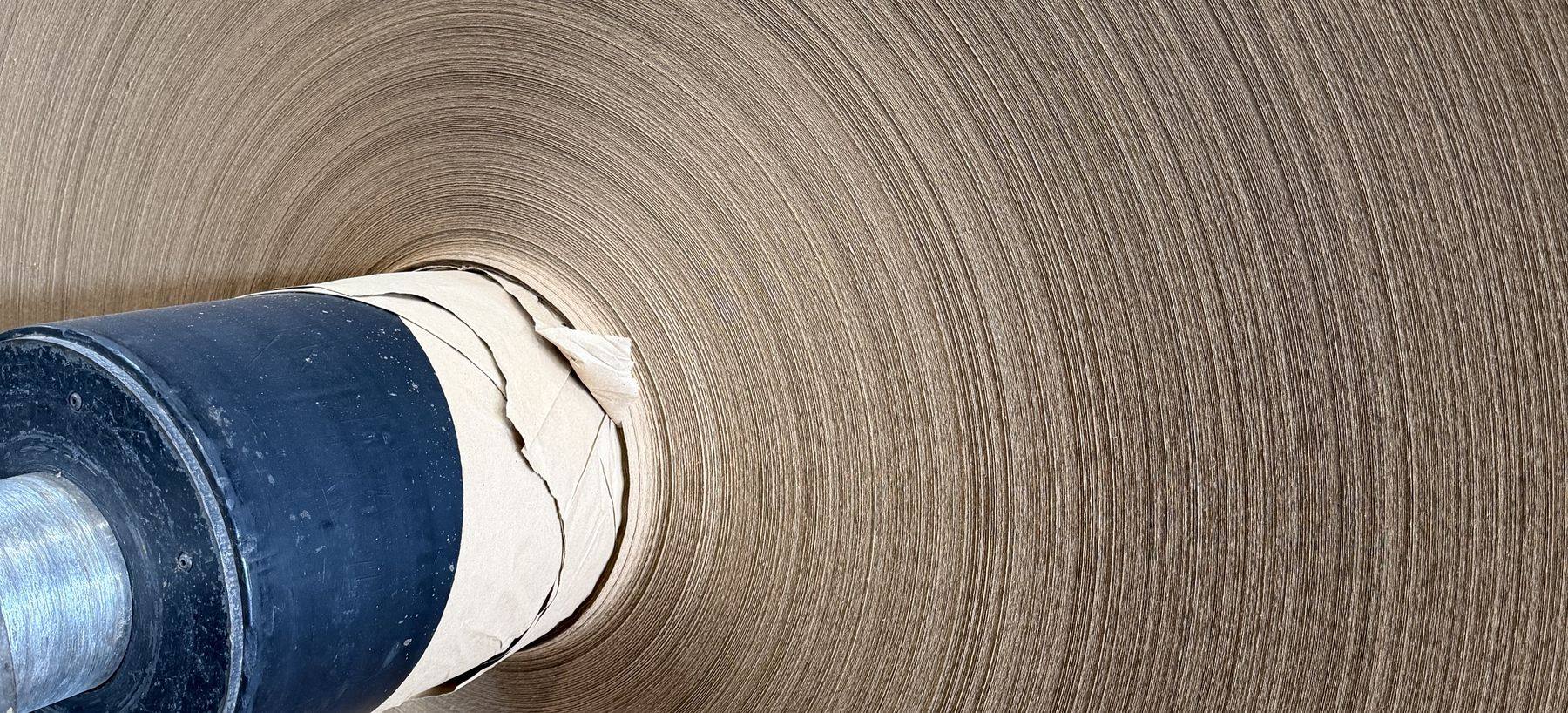
End of a finished paper roll showing the wound edge profile
Roll end profile, checked before wrapping at our mill near Cali

A technical note

How to read a specification sheet, including this one.

Most published grade data is honest. Some of it was written rather than measured, and the difference is visible from the page if you know where to look. None of what follows needs a laboratory. It needs the sheet read carefully, and it applies to ours as much as to anyone else's.

  • A method that is not cited. A tensile figure with no ISO 1924 part number is not a figure you can hold anyone to. Part 2 and part 3 pull at different speeds and give different results on the same paper, so a sheet that omits the part has not told you what it measured.
  • A tolerance that is not stated. A single number with no range is a target, not a commitment. The useful question is what the supplier does when a reel comes in under it.
  • Values that do not reconcile. An index is a measured value divided by grammage. Where a sheet prints both the index and the absolute figure, the two should agree. When they do not, one of them was typed rather than tested.
  • A property that is implausibly flat. Real measurement wanders. A figure that holds constant from the lightest to the heaviest weight in a family is usually a calculation from grammage rather than a result.
  • Tear anisotropy that inverts. MD and CD tear normally keep their relationship across a family. Where that flips at one end of the range with no note explaining it, something changed in the furnish or on the machine and the sheet did not say so.
  • A step between adjacent grades. Two neighbouring grades that ought to sit on a continuum, with an unexplained jump between them, often marks a different furnish or a different machine behind one of them.

None of this makes a supplier dishonest. Most of it is a sheet that was written once, by someone who has since left, and never checked against production again. But it does tell you which numbers you can plan a converting line around and which you cannot, and that is worth half an hour before you commit an annual volume.

If you want a second pair of eyes on a technical data sheet, ours or a current supplier's, send it over. We will tell you what it says, what it does not say, and which questions we would ask before putting volume behind it.

Growing the register

If your grade is missing, ask.

This register is short on purpose. A grade is listed once we hold a written specification for it and a machine has been qualified against that specification. Grades we can make but have not yet written a standard for are not here, and neither are grades where the published market data was too thin to set a defensible bar.

Mills across the Valle del Cauca approach us regularly, and each one brings a machine with its own capabilities. If what you need sits outside the six grades above, tell us anyway. There is a reasonable chance it is already in qualification, and if it is not, knowing there is a buyer is what makes us go and find the machine for it.

Ask about a grade
What comes with a quotation
SpecificationWritten targets and tolerances for your grade
Fiber contentDeclared composition of the grade offered
SamplePhysical samples on request before trial
Trial termsSingle container trial, priced for the run
Landed costFAS or CIF to your port
Lead timeQuoted against the current production plan

Send us your current supplier's specification.

We will tell you which of our mills can hold it, or that none of them can.

Request a quotation